The Wall Around Asgard
The Gods had made their way up to the top of a high mountain
and there they decided to build a great City for themselves that
the Giants could never overthrow. The City they would call
"Asgard," which means the Place of the Gods. They would
build it on a beautiful plain that was on the top of that high
mountain. And they wanted to raise round their City the
highest and strongest wall that had ever been built.
Now one day when they were beginning to build their halls
and their palaces a strange being came to them. Odin, the
Father of the Gods, went and spoke to him.
"What dost
thou want on the Mountain of the Gods?" he asked the
Stranger.
"I know what is in the mind of the Gods," the Stranger said.
"They would build a City here. I cannot build palaces, but I
can build great walls that can never be overthrown. Let the
build the wall round your City."
"How long will it take you to build a wall that will go round
our City?" said the Father of the Gods.
"A year, O Odin," said the Stranger.
Now Odin knew that if a great wall could be built around it
the Gods would not have to spend all their time defending their
City, Asgard, from the Giants, and he knew that if Asgard were
protected, he himself could go amongst men and teach them and
help them. He thought that no payment the Stranger could ask
would be too much for the building of that wall.
That day the Stranger came to the Council of the Gods, and
he swore that m a year he would have the great wall built. Then
Odin made oath that the Gods would give him what he asked in
payment if the wall was finished to the last stone in a year from
that day.
The Stranger went away and came back on the morrow. It
was the first day of Summer when he started work. He brought
no one to help him except a great horse.
Now the Gods thought that this horse would do no more than
drag blocks of stone for the building of the wall. But the horse
did more than this. He set the stones in their places and mor-
tared them together. And day and night and by hght and
dark the horse worked, and soon a great waU was rising round
the palaces that the Gods themselves were building.
"What reward will the Stranger ask for the work he is doing
for us?" the Gods asked one another
Odin went to the Stranger. "We marvel at the work you and
your horse are doing for us," he said. " No one can doubt that the
great wall of Asgard will be built up by the first day of Summer.
What reward do you claim? We would have it ready for you."
The Stranger turned from the work he was doing, leaving the
great horse to pile up the blocks of stone. "O Father of the
Gods," he said, "O Odin, the reward I shall ask for my work is
the Sun and the Moon, and Freya, who watches over the flowers
and grasses, for my wife."
Now when Odin heard this he was terribly angered, for the price
the Stranger asked for his work was beyond all prices. He went
amongst the other Gods who were then building their shining
palaces within the great wall and he told them what reward
the Stranger had asked. The Gods said, "Without the Sun and
the Moon the world will wither away." And the Goddesses
said, "Without Freya all will be gloom in Asgard."
They would have let the wall remain unbuilt rather than let
the Stranger have the reward he claimed for building it. But one
who was in the company of the Gods spoke. He was Loki, a
being who only half belonged to the Gods ; his father was the
Wind Giant. "Let the Stranger build the wall round Asgard,"
Loki said, " and I will find a way to make him give up the hard
bargain he has made with the Gods. Go to him and tell him that
the wall must be finished by the first day of Summer, and that
if it is not finished to the last stone on that day the price he asks
will not be given to him."
The Gods went to the Stranger and they told him that if the
last stone was not laid on the wall on the first day of the Summer
not Sol or Mani, the Sun and the Moon, nor Freya would be
given him. And now they knew that the Stranger was one of
the Giants.
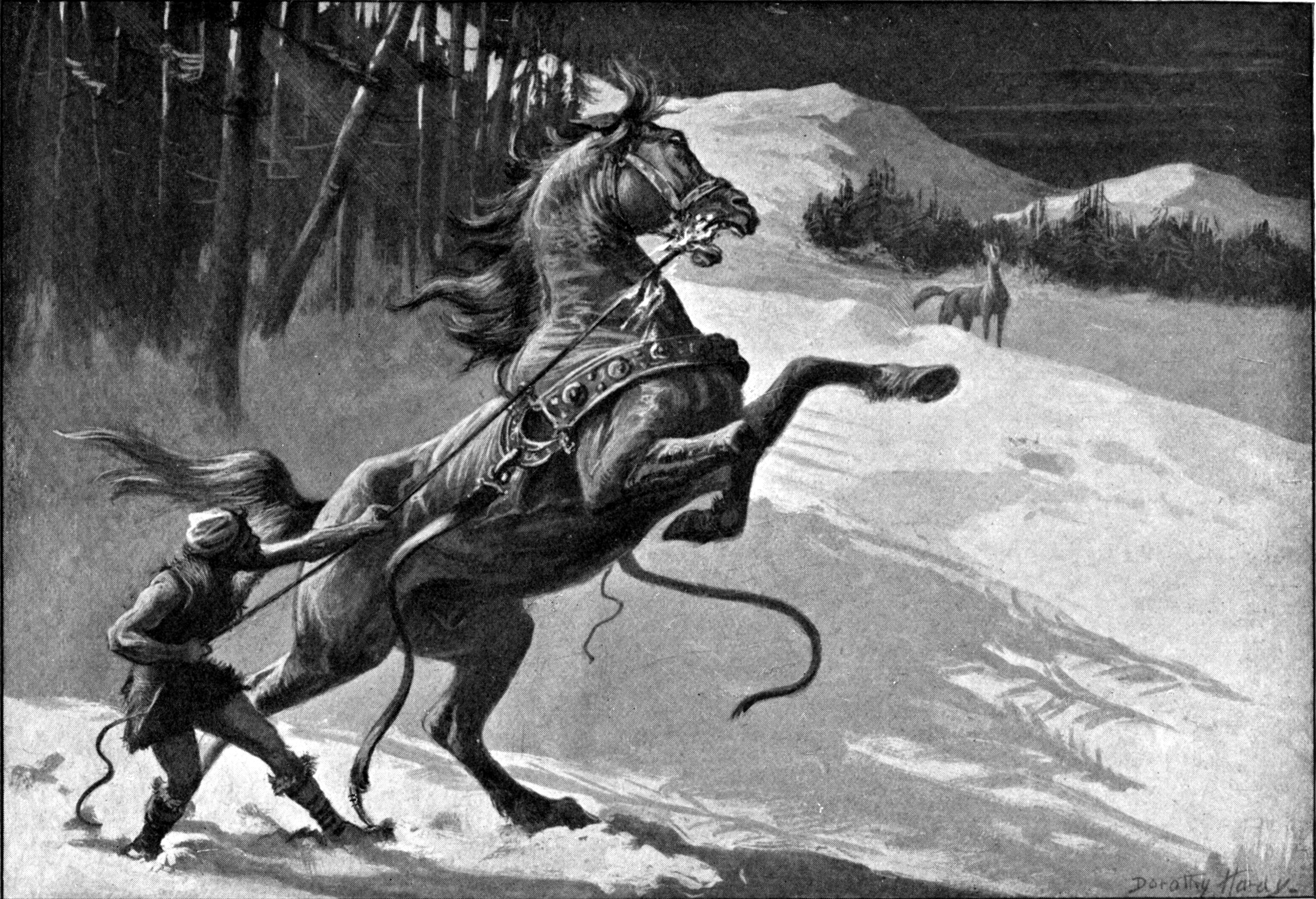
The Giant and his great horse piled up the wall more quickly,
than before. At night, while the Giant slept, the horse worked
on and on, hauling up stones and laying them on the wall with
his great forefeet. And day by day the wall around Asgard
grew higher and higher.
But the Gods had no joy in seeing that great wall rising higher
and higher around their palaces. The Giant and his horse would
finish the work by the first day of Summer, and then he would
take the Sun and the Moon, Sol and Mani, and Freya away
with him.
But Loki was not disturbed. He kept telling the Gods that
he would find a way to prevent him from finishing his work,
and thus he would make the Giant forfeit the terrible price he
had led Odin to promise him.
It was three days to Summer time. All the wall was finished
except the gateway. Over the gateway a stone was still to be
placed. And the Giant, before he went to sleep, bade his horse
haul up a great block of stone so that they might put it above
the gateway in the morning, and so finish the work two full days
before Summer.
It happened to be a beautiful moonlit night. Svadilfare, the
Giant's great horse, was hauling the largest stone he ever hauled
when he saw a httle mare come galloping towards him. The
great horse had never seen so pretty a little mare and he looked
at her with surprise. '
"Svadilfare, slave," said the little mare to him and went
frisking past.
Svadilfare put down the stone he was hauling and called to
the little mare. She came back to him. "Why do you call
me 'Svadilfare, slave'?" said the great horse.
"Because you have to work night and day for your master,'^,
said the httle mare. " He keeps you woTking, working, working,
and never lets you enjoy yourself. You dare not leave that stone
down and come and play with me."
"Who told you I dare not do it? " said Svadilfare.
"I know you daren't do it," said the little mare, and she
kicked up her heels and ran across the moonlit meadow.
Now the truth is that Svadilfare was tired of working day and
night. When he saw the little mare go galloping ofif he became
suddenly discontented. He left the stone he was hauling on the
ground. He looked round and he saw the little mare looking
back at him. He galloped after her.
He did not catch up on the little mare. She went on swiftly
before him. On she went over the moonlit meadow, turning
and looking back now and again at the great Svadilfare, who came
heavily after her. Down the mountain-side the mare went, and
Svadilfare, who now rejoiced in his liberty and in the freshness of
the wind and in the smell of the flowers, still followed her. With
the morning's light they came near a cave and the little mare went
into it. They went through the cave. Then Svadilfare caught
up on the little mare and the two went wandering together, the
little mare telling Svadilfare stories of the Dwarfs and the Elves.
They came to a grove and they stayed together in it, the little
mare playing so nicely with him that the great horse forgot all
about time passing. And while they were in the grove the Giant
was going up and down, searching for his great horse.
He had come to the wall in the morning, expecting to put the
stone over the gateway and so finish his work. But the stone
that was to be lifted up was not near him. He called for Svadil-
fare, but his great horse did not come. He went to search for him, and he searched all down the mountain-side and he searched
as far across the earth as the realm of the Giants. But he did not
find Svadilfare.
The Gods saw the first day of Summer come and the gateway
of the wall stand unfinished. They said to each other that if it
were not finished by the evening they need not give Sol and Mani
to the Giant, nor the maiden Freya to be his wife. The hours
of the summer day went past and the Giant did not raise the
stone over the gateway. In the evening he came before them.
"Your work is not finished," Odin said. "You forced us to a
hard bargain and now we need not keep it with you. You shall
not be given Sol and Mani nor the maiden Freya."
"Only the wall I have built is so strong I would tear it down,"
said the Giant. He tried to throw down one of the palaces,
but the Gods laid hands on him and thrust him outside the wall
he had built. "Go, and trouble Asgard no more," Odin com-
manded.
Then Loki returned to Asgard. He told the Gods how he
had transformed himself into a little mare and had led away
Svadilfare, the Giant's great horse. And the Gods sat in their
golden palaces behind the great wall , and rejoiced that their
City was now secure, and that no enemy could ever enter it
or overthrow it. But Odin, the Father of the Gods, as he sat
upon his throne was sad in his heart, sad that the Gods had got
their wall built by a trick ; that oaths had been broken, and that
a blow had been struck in injustice in Asgard.